


As a supplier of Industrial Pipe Benders, I've had the privilege of witnessing the pivotal role these machines play in various industries. One of the most frequently asked questions I encounter is about the bending force of an industrial pipe bender. In this blog post, I'll delve into what bending force is, how it's determined, and its significance in the world of pipe bending.
Understanding Bending Force
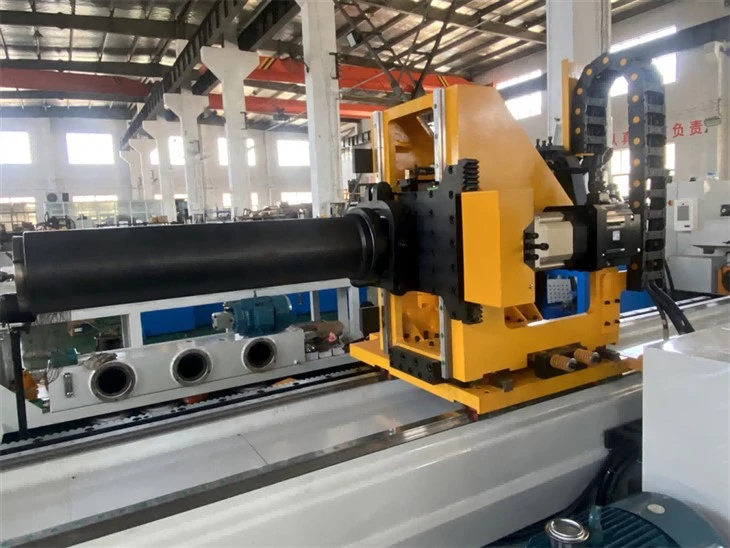
The bending force of an industrial pipe bender refers to the amount of force required to deform a pipe or tube into a desired shape. This force is crucial as it determines the machine's ability to bend pipes of different materials, sizes, and wall thicknesses. In simple terms, it's the muscle behind the bending process.
When a pipe is bent, it undergoes a complex set of mechanical stresses. The outer surface of the bend is stretched, while the inner surface is compressed. The bending force must be sufficient to overcome the material's resistance to these stresses and reshape the pipe without causing damage such as cracking, wrinkling, or flattening.
Factors Affecting Bending Force
Several factors influence the bending force required for a particular pipe bending operation. Understanding these factors is essential for selecting the right industrial pipe bender and achieving optimal bending results.
Material Properties
The material of the pipe is one of the most significant factors affecting bending force. Different materials have different mechanical properties, such as yield strength, tensile strength, and ductility. For example, steel pipes generally require more bending force than aluminum pipes due to their higher strength. Additionally, the presence of alloying elements or heat treatment can also affect the material's resistance to bending.
Pipe Size and Wall Thickness
The diameter and wall thickness of the pipe also play a crucial role in determining the bending force. Larger diameter pipes and thicker walled pipes require more force to bend compared to smaller and thinner pipes. This is because the cross - sectional area of the pipe increases with diameter and wall thickness, resulting in a greater amount of material that needs to be deformed.
Bend Radius
The bend radius is the radius of the curve into which the pipe is bent. A smaller bend radius requires more bending force than a larger bend radius. This is because a smaller bend radius subjects the pipe to more severe deformation, increasing the stress on the material.
Bending Method
There are different bending methods, such as rotary draw bending, roll bending, and press bending. Each method has its own characteristics and requires a different amount of bending force. For example, rotary draw bending is a precise method that can achieve tight bend radii but may require more force compared to roll bending, which is more suitable for large - radius bends.
Calculating Bending Force
Calculating the exact bending force for a specific pipe bending operation can be a complex task. However, there are some empirical formulas and guidelines that can be used as a starting point.
One of the most commonly used formulas for calculating the bending force in rotary draw bending is:
[F = K \times \sigma_y\times t^2\times D]
Where:

- (F) is the bending force
- (K) is a constant that depends on the bending method and material
- (\sigma_y) is the yield strength of the material
- (t) is the wall thickness of the pipe
- (D) is the outer diameter of the pipe
It's important to note that this formula provides an approximation, and actual bending forces may vary depending on factors such as tooling, lubrication, and machine efficiency.
Significance of Bending Force in Industrial Applications
The bending force of an industrial pipe bender has a significant impact on the quality and efficiency of pipe bending operations in various industries.
Automotive Industry
In the automotive industry, precision - bent pipes are used in exhaust systems, fuel lines, and chassis components. The ability to accurately control the bending force ensures that the pipes meet the strict quality and performance requirements. For example, a consistent bending force is necessary to prevent leaks in exhaust systems and ensure proper fuel flow in fuel lines.
Construction Industry
In construction, bent pipes are used in plumbing, HVAC systems, and structural applications. A powerful industrial pipe bender with the right bending force can handle large - diameter pipes and thick - walled pipes, making it suitable for building infrastructure projects.
Aerospace Industry
The aerospace industry demands the highest level of precision and quality in pipe bending. The bending force must be carefully controlled to ensure that the pipes can withstand the extreme conditions of flight. Any deviation in bending force can lead to structural failures or performance issues.
Our Industrial Pipe Benders
As a supplier of Industrial Pipe Benders, we offer a wide range of machines with different bending forces to meet the diverse needs of our customers. Our Pipe and Tube Bending Machines are designed with advanced technology and high - quality components to ensure reliable and efficient operation.
We also provide Semi - automatic Pipe Benders that offer a cost - effective solution for small - to - medium - scale pipe bending operations. These machines are easy to operate and can be customized to meet specific requirements.
Contact Us for Procurement
If you're in the market for an industrial pipe bender and need to understand the bending force requirements for your application, our team of experts is here to help. We can provide you with detailed information about our products, assist you in selecting the right machine, and offer comprehensive after - sales support.
Whether you're a small workshop or a large - scale manufacturing facility, we have the solution for your pipe bending needs. Contact us today to start a procurement discussion and take your pipe bending operations to the next level.
References
- Dieter, G.E. (1986). Mechanical Metallurgy. McGraw - Hill.
- Kalpakjian, S., & Schmid, S.R. (2008). Manufacturing Engineering and Technology. Pearson Prentice Hall.
- ASME B31.3 Process Piping Code.